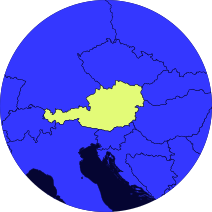
Austria, a largely mountainous landlocked country in south-central Europe. Together with Switzerland, it forms what has been characterized as the neutral core of Europe and has been a full member of the supranational European Union (EU) since 1995. Mountains and forests give the Austrian landscape its character, although in the northeastern part of the country, the Danube River winds between the eastern edge of the Alps and the hills of Bohemia and Moravia in its journey toward the Alföld, or Hungarian Plain. Vienna lies in the area where the Danube emerges from between the mountains into the drier plains.
BMK, the Austrian Federal Ministry for Climate Action, has participated actively in analyzing its characterization and identifying potential climate impacts (air pollution and GHG emissions) and sectors of interest (transport, energy, water, health and agriculture).
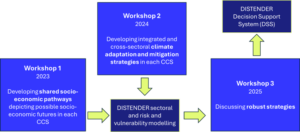
From 2023 to 2025, BMK has hosted three workshops (see figure below), convening a diverse group of local stakeholders to develop four shared socio-economic pathways (SSPs): SSP1 Earthlings help, care, and share; SSP5 Continuous globalized consumers’ society; SSP3 The Opposite of Development; SSP4 Frustration and Prosperity for the Austrian case study. Thanks to these workshops, 75 strategies were developed and later assessed against 26 indicators. These contributions and outcomes have been key to socio-economic scenarios and land use modelling for the Austrian case study. They have been incorporated into the DISTENDER Decision Support System (DSS) where they can be explored in.