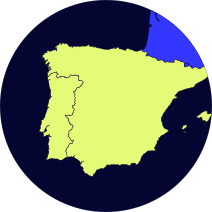
Dehesas (in Spain) and Montados (in Portugal) are silvopastoral systems characterized by open canopy woodlands of mainly Quercus rotundifolia and Quercus suber, with natural or cultivated grassland. Covering around 3.5 million ha in the South-western region of the Iberian Peninsula, these human-shaped ecosystems have long been acknowledged as land use systems of high nature and social value (HNSV), providing relevant ecosystem services and biodiversity conservation. This is a result of the high diversity in vegetation, fauna and land cover, and the balance between forestry and grazing uses, all coexisting within the constraining environmental conditions of the Mediterranean region. The system is now under severe threats, either due to poor or non-existent land-management practices, leading to extensification and abandonment in less fertile areas or due to pressure for intensification and overuse in others.
EURAF, the European Agroforestry Federation that represents Dehesas and Montados case study, has participated actively in its characterization and the initial identification of potential climate impacts (droughts and torrential rains, extreme temperatures and heat waves, water scarcity and locally observed strong winds) and sectors directly affected (agriculture sector) for Dehesas and Montados in Portugal and Spain.
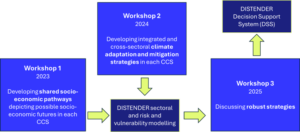
In the 2023-2025 period EURAF has hosted three workshops (see figure below) convening local stakeholders where four shared socio-economic pathways (SSP1: Optimistic Silvo-pastoralism; SSP3: Unsustainable management for a dehumanized world; SSP4: Chronicle of a death foretold; SSP5: Bye-bye Dehesa and Montado) were developed for Dehesas and Montados case. Thanks to these workshops, 64 strategies were developed and were later assessed against 26 indicators. These contributions and outcomes have been key in socio-economic scenarios and land use modelling for Dehesas and Montados case and they have fed and can be explored in DISTENDER Decision Support System (DSS).